
If you’re planning to install uPVC windows or doors, you’ve probably heard the term uPVC profile. While it may sound technical, understanding what a profile is can help you choose better-quality windows that last for decades.
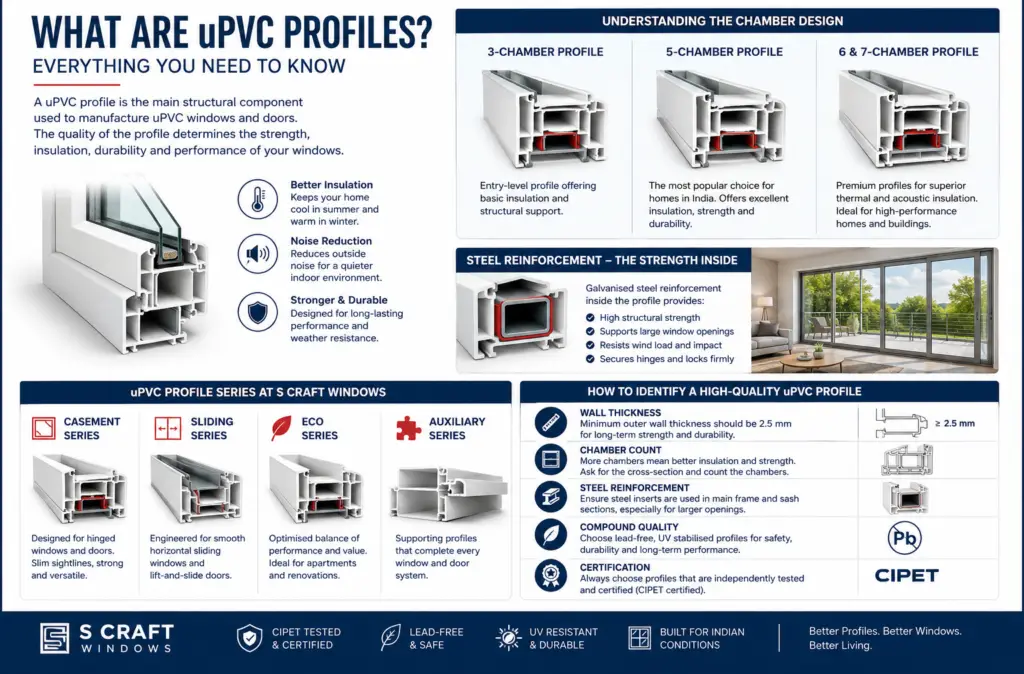
Simply put, a uPVC profile is the main structural component used to manufacture uPVC windows and doors. Every frame, sash, and door panel starts as a specially designed profile. The strength, durability, insulation, and overall performance of your windows depend largely on the quality of these profiles.
Choosing high-quality profiles means investing in windows that are stronger, more energy-efficient, quieter, and easier to maintain.
What Exactly Is a uPVC Profile?
A uPVC profile is a specially engineered section made from Unplasticized Polyvinyl Chloride (uPVC) using a manufacturing process called extrusion.
These profiles are produced in long lengths with carefully designed cross-sections containing multiple hollow chambers. They are then cut, reinforced, welded, and assembled into complete windows and doors.
Think of a uPVC profile as the backbone of a window. Just as a building relies on a strong foundation, every quality window depends on a well-designed profile.
A premium profile provides:
- Excellent structural strength
- Better thermal insulation
- Improved sound reduction
- Longer service life
- Smooth operation of hardware and accessories
Understanding the Chamber Design
One of the most important features of a uPVC profile is its multi-chamber design.
Inside every profile are several hollow compartments separated by internal walls. These compartments, known as chambers, trap air inside the profile.
Since air is a natural insulator, these chambers help reduce heat transfer and improve energy efficiency while also increasing the overall strength of the frame.
3-Chamber Profiles
Three-chamber profiles are generally used for basic residential applications where budget is the primary consideration.
They provide adequate strength and insulation but are best suited for areas with moderate performance requirements.
5-Chamber Profiles
Five-chamber profiles are the preferred choice for most modern homes in India.
They offer an excellent balance of:
- Better insulation
- Increased structural strength
- Improved noise reduction
- Enhanced durability
For most homeowners, a quality five-chamber profile delivers reliable long-term performance.
6 & 7-Chamber Profiles
Premium six and seven-chamber profiles are designed for projects that demand maximum performance.
These profiles provide:
- Superior thermal insulation
- Better soundproofing
- Greater structural rigidity
- Higher energy efficiency
They are commonly used in luxury homes, villas, premium apartments, and commercial buildings.
Why Steel Reinforcement Is Important
Although uPVC is strong, large windows and doors require additional support.
That’s why quality uPVC profiles include galvanised steel reinforcement inside selected chambers.
The steel reinforcement helps:
- Prevent frame bending or warping
- Support larger window openings
- Improve wind resistance
- Secure hinges and locking systems
- Increase the overall lifespan of the window
At S Craft Windows, all major window and door profiles are reinforced with high-quality galvanised steel to ensure long-lasting structural performance.
Types of uPVC Profiles Used at S Craft Windows
Casement Profiles
Casement profiles are designed for windows and doors that open outward or inward using hinges.
They provide:
- Strong frame construction
- Slim and elegant appearance
- Support for single and double glazing
- Excellent weather sealing
These are ideal for bedrooms, living rooms, kitchens, and balconies.
Sliding Profiles
Sliding profiles are specially engineered for horizontal sliding windows and doors.
They feature:
- Smooth roller movement
- Strong sash sections
- Efficient drainage channels
- Space-saving operation
Sliding systems are perfect where space is limited while still providing wide openings.
Eco Profiles
Eco profiles offer an excellent combination of affordability and performance.
They are suitable for:
- Residential apartments
- Renovation projects
- Budget-conscious homeowners
Despite being economical, they maintain excellent durability and structural integrity.
Auxiliary Profiles
Auxiliary profiles are supporting components that complete the window system.
These include:
- Mullions
- Transoms
- Sub-frames
- Adaptor sections
- Fixing channels
Although less visible, these components are essential for proper installation and long-term performance.
How to Identify a High-Quality uPVC Profile
Not all uPVC profiles are manufactured to the same standards. Before making a purchase, consider the following factors.
Wall Thickness
The outer wall should generally be at least 2.5 mm thick.
Thicker walls provide:
- Better strength
- Greater impact resistance
- Improved durability
- Longer service life
Chamber Design
A higher number of chambers generally improves insulation and structural performance.
Always ask to see the profile cross-section so you can understand its internal design.
Steel Reinforcement
Ensure the primary frame and sash sections contain galvanised steel reinforcement, especially for larger windows and doors.
This significantly improves strength and long-term stability.
Lead-Free Material
Choose profiles manufactured using lead-free uPVC compounds.
Lead-free profiles are:
- Safer for families
- Environmentally friendly
- More sustainable
- Compliant with modern manufacturing standards
Certification
Always look for independently tested profiles.
At S Craft Windows, our profiles are CIPET tested, ensuring they meet industry standards for:
- Material quality
- Dimensional accuracy
- Mechanical strength
- UV resistance
- Long-term durability
Why Profile Quality Matters
Many homeowners compare only the final price of a window, but the quality of the profile has a much greater impact on long-term performance.
A premium uPVC profile offers:
- Better insulation from heat
- Reduced outside noise
- Greater structural strength
- Smooth operation for years
- Lower maintenance
- Improved security
- Longer product life
Choosing a trusted profile today helps avoid expensive repairs and replacements in the future.
Frequently Asked Questions
What is the difference between a uPVC profile and a uPVC window?
A uPVC profile is the raw structural section used to manufacture windows and doors. Once it is cut, reinforced, welded, fitted with glass, and assembled with hardware, it becomes a complete uPVC window or door.
How many chambers should a good uPVC profile have?
For most Indian homes, a five-chamber profile provides the ideal balance of strength, insulation, and durability. Premium homes or commercial buildings may benefit from six or seven-chamber profiles.
Does wall thickness really matter?
Yes. Thicker profile walls improve structural stability, resist impact, provide better support for hardware, and increase the lifespan of the window.
Are all uPVC profiles lead-free?
No. Some low-cost profiles still use lead-based stabilisers. Always ask for proof that the profiles are lead-free. S Craft Windows uses lead-free, CIPET-tested profiles that meet modern quality standards.