
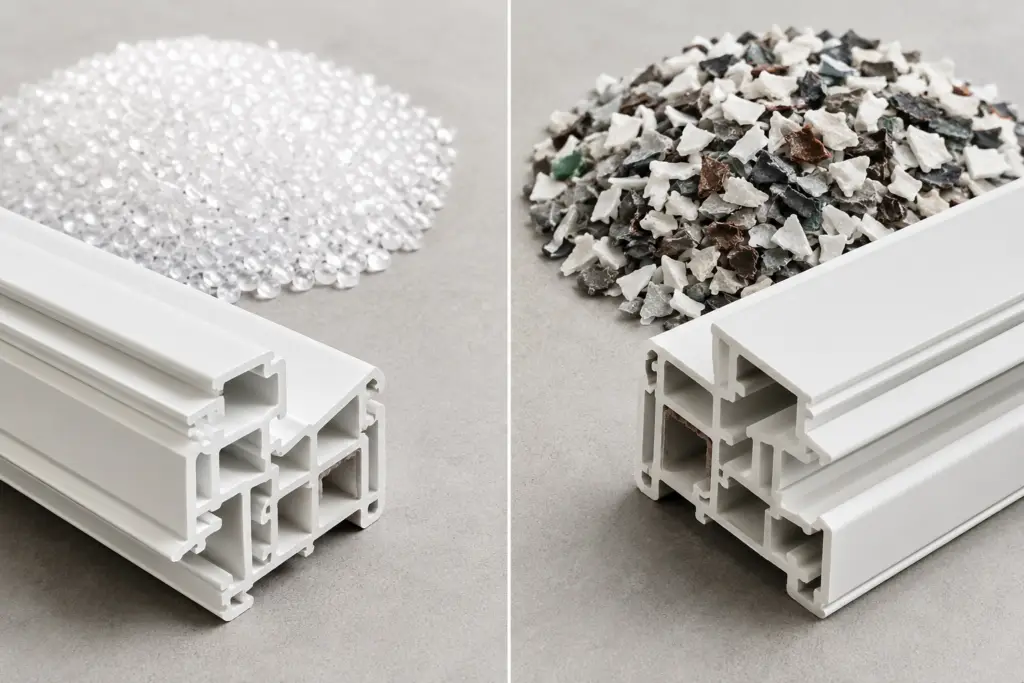
The difference between virgin uPVC and recycled uPVC begins with the source and processing history of the material. Virgin material starts with new polymer resin while recycled material comes from previously processed PVC or uPVC material that has been recovered and reprocessed.
However the words “virgin” and “recycled” alone do not explain complete uPVC profile quality.
Material formulation, contamination control, extrusion conditions, profile geometry and technical testing also matter.
For fabricators and buyers the better question is not simply whether a profile contains virgin or recycled material.
The important question is: How is the material controlled and is the finished uPVC profile suitable for its intended window or door application?
First, What Does Virgin uPVC Mean?
The term virgin material refers to polymer raw material that has not previously been converted into another finished PVC product and then recovered for reuse.
In uPVC profile manufacturing the primary polymer starts with PVC resin.
What is PVC resin?
PVC stands for Polyvinyl Chloride.
PVC resin is the base polymer raw material used to prepare a uPVC compound.
The resin itself is not the complete profile formulation.
A manufacturer prepares a controlled compound using the base polymer and relevant formulation components required for processing and intended material performance.
What Is a uPVC Compound?
A uPVC compound is the prepared material formulation processed through an extrusion line to manufacture a uPVC profile.
Think of it this way:
PVC resin is the base polymer.
The formulation defines the controlled material combination.
The prepared compound is processed during extrusion.
The uPVC profile is the finished extruded section.
These terms are related but they do not mean the same thing.
What Does Recycled uPVC Mean?
Recycled uPVC generally refers to PVC or uPVC material that has been recovered and processed for reuse.
The source of recycled material can vary.
It may come from controlled production material or previously manufactured products depending on the recycling system.
This difference in source is important.
Not all recycled material should automatically be treated as technically identical.
What Is Regrind?
The term regrind is commonly used in plastics processing.
Regrind refers to processed material that has been mechanically reduced into smaller particles so it can potentially be processed again.
For example material generated during a controlled manufacturing process may be collected, segregated and processed according to the manufacturer’s material control system.
This is different from assuming that any mixed plastic waste can be placed into a uPVC profile extrusion line.
Material identification and contamination control are important.
What Is Post-Industrial Material?
Post-industrial material is material recovered from a manufacturing or industrial process before reaching the final consumer.
Depending on the manufacturing process this may include controlled production material.
The source and handling process should be clearly understood.
Material that remains correctly identified and segregated is different from unknown mixed plastic waste.
What Is Post-Consumer Recycled Material?
Post-consumer material comes from products that have already completed their original use.
For example an old PVC product recovered after its service life may enter a recycling process.
Post-consumer recycling requires appropriate collection, sorting, identification and processing.
The material history can be more complex because the recovered products may have been manufactured using different formulations or intended for different applications.
Virgin uPVC vs Recycled uPVC Profiles: The Basic Difference
| Factor | Virgin Material | Recycled Material |
|---|---|---|
| Material Source | New polymer raw material | Previously processed or used material |
| Processing History | No previous product processing history | Has undergone previous processing |
| Source Control | Based on supplied raw material specification | Depends on recovery and sorting system |
| Material Variation | Can support controlled formulation preparation | Can vary depending on material source |
| Contamination Risk | Depends on raw material handling | Requires careful segregation and contamination control |
| Evaluation | Formulation and finished profile testing matter | Source control, processing and finished profile testing matter |
This table explains the material source difference.
It does not mean that the word “virgin” automatically proves every quality claim.
It also does not mean that all recycled material behaves identically.
1. Material Source Is the First Difference
Virgin and recycled materials begin with different material histories.
Virgin polymer raw material enters the formulation without a previous finished product lifecycle.
Recycled material has already undergone processing or product use before recovery.
Why does material history matter?
Polymers experience processing conditions during manufacturing.
Depending on the material and process these conditions can influence material behaviour.
For recycled material the manufacturer needs to understand factors such as:
- Material source
- Previous application
- Material identification
- Contamination
- Sorting
- Reprocessing history
This is why the term “recycled” alone provides limited technical information.
2. Formulation Control Matters
A uPVC profile is not manufactured from a descriptive label.
It is manufactured from a controlled material formulation.
What is formulation control?
Formulation control means managing the materials and proportions used to prepare a compound according to a defined manufacturing specification.
Different formulation components can have specific processing or material-related purposes.
The exact formulation is generally part of a manufacturer’s technical production knowledge.
For fabricators the practical point is simple.
Consistent material preparation supports consistent processing.
A profile supplier should be evaluated through finished product consistency and available technical evidence rather than one marketing word.
3. Contamination Control Is Important
Contamination means the presence of unwanted or incompatible material within a manufacturing material stream.
This can become particularly relevant when recovered material comes from uncontrolled or mixed sources.
Possible contamination concerns can include:
- Different polymer types
- Dirt
- Foreign particles
- Unknown material grades
- Mixed colours
- Unidentified processing residues
This does not mean every recycled material stream is contaminated.
It means material segregation and identification become important parts of recycling control.
What Is Material Segregation?
Material segregation is the process of keeping different materials or material streams separated.
For example a controlled uPVC production material stream should not be casually mixed with unidentified plastics.
Different polymers can have different processing characteristics.
Correct material identification supports better process control.
4. Processing Consistency Affects Extrusion
uPVC profiles are manufactured using an extrusion process.
During extrusion the prepared compound is processed and shaped into a continuous profile section.
What is extrusion?
Extrusion is a continuous manufacturing process used to create a defined profile shape.
The material passes through extrusion equipment and precision tooling before calibration and cooling.
Material behaviour during processing needs to remain within controlled production conditions.
Variation in the material can create additional processing challenges.
This is why material preparation and extrusion control are closely connected.
5. Profile Appearance Should Be Evaluated
A visual profile inspection can identify obvious surface concerns.
Fabricators should inspect multiple profile lengths rather than checking only one sample.
Look for:
- Surface consistency
- Visible impurities
- Unexplained colour variation
- Pitting
- Cavities
- Irregular patches
- Damaged profile sections
A smooth surface does not prove every material property.
However visible inconsistencies can justify further inspection.
6. Colour Alone Does Not Prove Virgin Material
This is an important misconception.
A bright white profile should not automatically be described as virgin uPVC based only on visual appearance.
Colour is not a complete material identification test.
The same applies in reverse.
A slight visual variation should not be used to make an unsupported claim about the material source.
Material claims should be supported by manufacturing information and relevant technical documentation.
7. UV Performance Needs Technical Context
UV stands for ultraviolet radiation.
Window and door profiles installed on buildings can experience sunlight exposure.
The material formulation and stabilisation approach are relevant to UV-related performance.
What is UV resistance?
UV resistance refers to a material’s ability to resist degradation associated with ultraviolet exposure under defined conditions.
Do not assume that the word “virgin” automatically proves unlimited UV resistance.
Do not assume that a visual demonstration proves long-term outdoor performance.
Relevant testing and material evaluation provide better technical context.
8. Impact Performance Should Be Tested
Impact performance relates to how a material responds to sudden force under specified test conditions.
Informal profile demonstrations are common in product marketing.
A person may bend, hit or drop a profile.
These demonstrations do not automatically replace a defined technical test.
A proper test follows a specified method and controlled test conditions.
Fabricators and project professionals should ask what was tested and which test method was used.
9. Dimensional Consistency Still Matters
Material source is only one part of profile evaluation.
A uPVC profile also needs controlled geometry.
What is dimensional consistency?
Dimensional consistency means maintaining the intended profile measurements within defined manufacturing tolerances.
Important areas can include:
- Overall profile dimensions
- Wall sections
- Reinforcement chambers
- Gasket grooves
- Glazing bead areas
- Interlocking sections
A profile can be marketed using strong material claims but fabricators still need repeatable dimensions during production.
10. Finished Profile Testing Is More Useful Than Assumptions
The final uPVC profile should be evaluated according to relevant technical requirements.
Depending on the profile and test objective evaluation may include:
- Appearance
- Dimensions
- Material properties
- Impact-related performance
- UV-related performance
- Thermal material behaviour
Why does finished product testing matter?
The finished profile represents the result of:
Raw material selection
Formulation
Mixing
Extrusion
Die shaping
Calibration
Cooling
Process control
Testing the relevant finished product characteristics provides more technical information than relying only on a raw material label.
Does Virgin uPVC Automatically Mean a High-Quality Profile?
No.
Virgin raw material describes the source or processing history of the base material.
It does not automatically confirm:
- Correct formulation
- Controlled extrusion
- Accurate dimensions
- Suitable profile geometry
- Proper calibration
- UV performance
- Impact performance
- Fabrication compatibility
A manufacturer still needs to control the complete profile production process.
This is why buyers should avoid evaluating profile quality using one feature alone.
Does Recycled Material Automatically Mean Poor Quality?
The answer requires technical context.
Recycled material can come from different sources and processing systems.
Controlled industrial material is different from unidentified mixed plastic waste.
The application also matters.
A manufacturer needs to evaluate material suitability according to the intended product and relevant technical requirements.
For window and door profiles exposed to external environmental conditions the finished profile’s material performance, processing consistency and technical compliance need careful evaluation.
Avoid making a quality conclusion based only on the word “recycled”.
Ask for specific technical information.
What Should Fabricators Ask a uPVC Profile Supplier?
Fabricators should ask practical questions.
1. What profile systems are available?
Understand whether the supplier offers sliding, casement or supporting profile systems relevant to your fabrication work.
2. Are profile technical drawings available?
Technical drawings help fabricators understand profile dimensions and geometry.
3. What reinforcement sections are specified?
Check reinforcement compatibility with the profile system.
4. What technical testing documentation is available?
Ask for relevant profile or material test reports where available.
5. How is dimensional consistency checked?
Understand how the supplier evaluates profile dimensions during production.
6. Can profile samples be evaluated during fabrication?
Actual production evaluation can help fabricators observe cutting, reinforcement insertion, welding and component fitting.
7. How consistent is regular supply?
For a fabrication business profile supply consistency can be as important as initial sample quality.
Practical uPVC Profile Material Checklist
| Check | What to Ask or Inspect | Why It Matters |
| Material Claim | Ask what the material description means | Avoids vague terminology |
| Profile Surface | Inspect multiple profile lengths | Identifies visible inconsistencies |
| Colour | Compare under similar lighting | Supports visual consistency checks |
| Dimensions | Check against available specifications | Supports fabrication consistency |
| Profile Geometry | Inspect the profile cross-section | Helps understand system design |
| Reinforcement Chamber | Check compatible reinforcement | Supports correct fabrication |
| Technical Testing | Review relevant reports | Provides documented evidence |
| Fabrication Behaviour | Test during actual production | Shows practical processing behaviour |
| Supply Consistency | Compare different supplies over time | Important for repeatable production |
Common uPVC Material Terms You Should Know
Virgin Material
Polymer raw material that has not previously been converted into another finished product and recovered for reuse.
Recycled Material
Material recovered from a previous manufacturing process or product lifecycle and processed for reuse.
Regrind
Processed plastic material mechanically reduced into smaller particles for potential reprocessing.
Post-Industrial Material
Material recovered from a manufacturing or industrial process before final consumer use.
Post-Consumer Material
Material recovered from products after their original consumer use.
PVC Resin
The base polymer raw material used in the preparation of a uPVC compound.
uPVC Compound
The prepared formulation processed during uPVC profile extrusion.
Formulation
The controlled combination of materials used to prepare a manufacturing compound.
Polymer
A material made from large molecular structures. PVC is a type of polymer.
Contamination
The presence of unwanted or incompatible material within a material stream.
Material Segregation
The controlled separation of different materials or material sources.
Extrusion
The continuous manufacturing process used to form uPVC profile sections.
Profile Geometry
The shape and arrangement of walls, chambers and functional sections within a profile.
Dimensional Tolerance
The permitted variation from a specified measurement.
UV Resistance
The ability of a material to resist degradation associated with ultraviolet exposure under defined conditions.
Impact Performance
The behaviour of a material when subjected to sudden force under specified test conditions.
Common Misconceptions About Virgin and Recycled uPVC
Misconception 1: White Colour Proves Virgin uPVC
Colour alone cannot confirm the material source.
Material claims need appropriate manufacturing and technical evidence.
Misconception 2: Virgin Material Guarantees a Perfect Window
The profile is only one part of the complete window system.
Fabrication, reinforcement, glass, gaskets, hardware and installation also matter.
Misconception 3: Every Recycled Material Is the Same
Recovered material can come from different sources.
Controlled production material and unidentified mixed waste should not automatically be treated as technically identical.
Misconception 4: Profile Weight Proves Material Quality
Weight can be influenced by profile size and geometry.
A heavier profile does not automatically prove better material quality.
Misconception 5: Marketing Terms Replace Testing
Words such as pure, premium and strong need technical context.
Relevant test documentation provides more useful information.
S Craft Perspective
From a uPVC profile manufacturing perspective raw material selection is only the beginning of the production process.
Material preparation, formulation control, extrusion conditions, calibration and dimensional inspection all contribute to the consistency of a finished profile.
S Craft’s uPVC profile positioning focuses on profile systems for window and door fabrication. For fabricators the practical evaluation should include profile geometry, dimensional repeatability, reinforcement compatibility, fabrication behaviour and available technical documentation.
The virgin uPVC vs recycled uPVC discussion should therefore move beyond simple labels.
The material source matters but finished profile quality needs to be evaluated through the complete manufacturing and quality control process.
Frequently Asked Questions About Virgin and Recycled uPVC Profiles
1. What is the difference between virgin uPVC and recycled uPVC?
Virgin material begins with new polymer raw material that has not previously completed another product lifecycle. Recycled material comes from previously processed or used PVC or uPVC material that has been recovered for reuse. The source and processing history are the main differences.
2. Is virgin uPVC always better than recycled uPVC?
The word virgin alone does not prove complete profile quality. Formulation, extrusion control, profile geometry, dimensions and relevant testing also matter. The finished profile should be evaluated according to its intended application.
3. How can I identify a virgin uPVC profile?
Visual appearance alone cannot reliably confirm the material source. Buyers and fabricators should ask the profile manufacturer for material information and relevant technical documentation instead of judging only by colour or surface appearance.
4. What is regrind in uPVC manufacturing?
Regrind is previously processed plastic material that has been mechanically reduced into smaller particles for potential reprocessing. Its source, identification and handling are important when evaluating how the material may be reused.
5. Does recycled uPVC always contain mixed plastic waste?
No. Recycled material can come from different sources. Controlled post-industrial material is different from unidentified mixed waste. Material segregation and source control are important factors.
6. Does white colour indicate better uPVC quality?
No. White colour alone cannot confirm material formulation, dimensional consistency, UV resistance or impact performance. Profile quality should be evaluated using multiple technical and practical checks.
7. Why is material formulation important in uPVC profiles?
The formulation creates the prepared compound used during extrusion. Controlled material preparation supports processing consistency and influences relevant material characteristics of the finished profile.
8. What should fabricators check before buying uPVC profiles?
Fabricators should inspect profile dimensions, geometry, surface consistency, reinforcement compatibility and fabrication behaviour. They should also review relevant technical documentation and evaluate regular supply consistency.
Continue Learning
How to Check uPVC Profile Quality: 10 Practical Checks
Learn the physical and technical checks that can help you evaluate uPVC profile quality.
How uPVC Profiles Are Manufactured
Understand compound preparation, extrusion, calibration, cooling and finished profile inspection.
Explore S Craft uPVC Profile Systems
Review profile systems developed for sliding, casement and supporting window and door applications.
Evaluating uPVC Profiles for Your Fabrication Business?
Material terminology is useful but profile selection should involve a complete technical evaluation.
Speak with the S Craft team to understand available uPVC profile systems, profile applications and supply requirements for your fabrication business.