
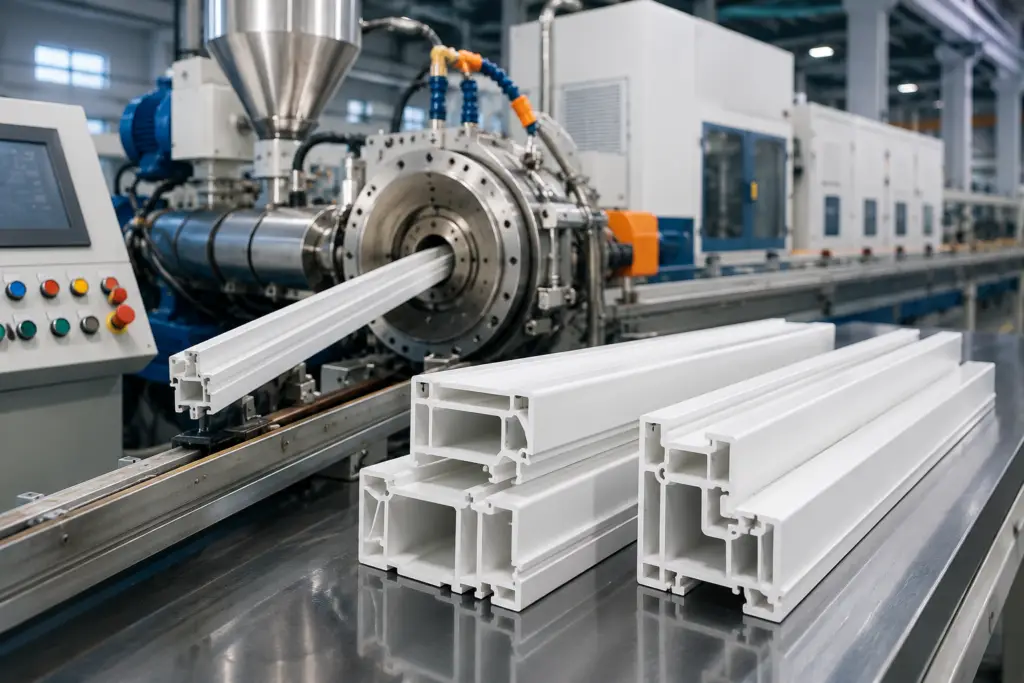
The uPVC profile manufacturing process converts a prepared uPVC compound into precision-shaped profile sections used in window and door systems. The process involves material preparation, controlled mixing, extrusion, die shaping, calibration, cooling, haul-off, cutting and quality inspection.
Each manufacturing stage affects the consistency of the finished profile.
Understanding how uPVC profiles are manufactured helps fabricators, builders and dealers evaluate profile quality beyond colour, weight and price.
First, What Is a uPVC Profile?
uPVC stands for Unplasticized Polyvinyl Chloride.
It is a rigid polymer material commonly used to manufacture profile sections for window and door systems.
A uPVC profile is a continuous shaped section produced through an extrusion process.
Profiles can be designed for different functions within a window or door system.
Common profile types include:
- Frame profiles
- Sash profiles
- Mullion profiles
- Sliding track profiles
- Glazing beads
- Interlock profiles
- Coupling profiles
- Auxiliary profiles
The exact profile geometry depends on the window or door system.
A uPVC profile is not a complete window.
The finished window system may also include glass, reinforcement, gaskets, hardware and other components. Fabrication and installation also influence final window performance.
Why Does the uPVC Profile Manufacturing Process Matter?
A fabricator needs profile sections that remain consistent from one length to another.
Unexpected dimensional changes can affect cutting, welding, reinforcement insertion and component fitting.
For builders and project professionals profile manufacturing knowledge helps create a better technical evaluation process when comparing suppliers.
The manufacturing process matters because profile production requires control over:
- Material preparation
- Processing conditions
- Profile geometry
- Dimensions
- Surface appearance
- Cooling
- Production consistency
A profile may appear simple from the outside.
Its cross-section often contains chambers, grooves, walls and functional areas that must be formed consistently during production.
Step 1: uPVC Compound Preparation
The manufacturing process begins with the material formulation.
The base material is PVC resin.
What is PVC resin?
PVC resin is the primary polymer raw material used in the preparation of a uPVC compound.
The resin alone does not represent the complete profile formulation.
A controlled formulation can include different additives depending on the required processing and material properties.
These may include relevant stabilising, processing and performance-related components.
The exact formulation is a technical manufacturing specification and can differ between manufacturers.
What Is a uPVC Compound?
A uPVC compound is the prepared material mixture processed through the extrusion system to manufacture a profile.
In simple terms:
PVC resin is the base polymer.
The compound is the prepared formulation used for profile production.
This distinction is important because profile performance cannot be understood by looking only at the base PVC resin.
The complete formulation and manufacturing control influence material behaviour.
Step 2: Controlled Material Mixing
The raw materials used in the formulation need to be mixed under controlled processing conditions.
This stage is often referred to as compound mixing.
The purpose is to create a consistent material mixture before extrusion.
Why is mixing important?
Poor material distribution can affect processing consistency.
The mixing stage helps prepare the compound for controlled extrusion.
Manufacturers need to monitor relevant process parameters according to their production formulation and equipment.
What is a process parameter?
A process parameter is a controlled manufacturing condition.
Examples can include:
- Temperature
- Mixing time
- Machine speed
- Material feed rate
- Cooling conditions
The relevant parameters depend on the manufacturing stage.
Process control means monitoring these conditions to maintain repeatable production.
Step 3: Material Feeding Into the Extruder
After material preparation the compound is supplied to the extrusion equipment.
The machine used for this process is called an extruder.
What is an extruder?
An extruder is manufacturing equipment that processes material and pushes it through specialised tooling to create a continuous shape.
In uPVC profile manufacturing the extruder processes the prepared compound under controlled conditions.
The material moves through the extrusion system before reaching the profile die.
What happens inside the extruder?
The material experiences controlled processing as it moves through the machine.
The extrusion system must maintain suitable processing conditions for the selected formulation and profile design.
Temperature and material flow need careful control.
Incorrect processing conditions may contribute to production inconsistencies.
Step 4: The Profile Is Shaped Through a Die
The processed material reaches a specialised tool called a die.
The die is one of the most important components in profile extrusion.
What is an extrusion die?
An extrusion die is precision tooling designed to help form the required cross-sectional shape of a profile.
Imagine cutting a uPVC profile and looking directly at the cut section.
You may see:
- Outer walls
- Internal walls
- Chambers
- Grooves
- Reinforcement areas
- Glazing-related sections
- Interlocking features
This complete sectional design is called the profile cross-section or profile geometry.
The extrusion die is engineered according to this geometry.
What Is Profile Geometry?
Profile geometry refers to the shape and arrangement of the different sections within a profile cross-section.
It can include:
- Overall profile dimensions
- Internal chamber layout
- Wall sections
- Gasket grooves
- Reinforcement provision
- Glazing bead areas
- Interlocking sections
Profile geometry is not designed only for visual appearance.
Different sections perform specific functions within the intended profile system.
This is why two white uPVC profiles can look similar from a distance but have different internal designs.
Step 5: Profile Calibration
After the profile exits the die its shape needs to be controlled.
This stage is called calibration.
What is calibration in uPVC profile manufacturing?
Calibration is the controlled production stage used to help maintain the intended profile shape and dimensions after extrusion.
The newly formed profile requires dimensional control as it continues through the production line.
Calibration equipment works according to the required profile geometry.
Why is calibration important?
Without suitable dimensional control profile geometry may not remain within the intended manufacturing requirements.
Calibration supports consistency in areas such as:
- Profile width
- Profile height
- Functional grooves
- Chamber geometry
- Component fitting areas
For fabricators these dimensions can influence profile processing and system compatibility.
Step 6: Controlled Profile Cooling
The profile must cool after the forming and calibration stages.
Cooling is not simply a matter of leaving the profile in open air.
It forms part of the controlled production process.
Why is cooling important?
The profile needs to maintain its intended geometry as it moves through the manufacturing line.
Cooling conditions can influence dimensional stability during production.
The production line must coordinate extrusion, calibration and cooling conditions.
What is dimensional stability?
Dimensional stability refers to the ability of a material or component to maintain its intended dimensions under specified conditions.
In profile manufacturing dimensional control is important because system components are designed to interact with one another.
A glazing bead needs to match its intended profile system.
A reinforcement chamber needs to accommodate the specified reinforcement.
A sash and frame system needs compatible geometry.
Consistency supports these relationships.
Step 7: The Haul-Off System Controls Profile Movement
The continuous profile moves along the extrusion line using a haul-off system.
What is a haul-off system?
A haul-off system is equipment that pulls the profile through the production line at a controlled rate.
The movement of the profile needs to remain coordinated with the extrusion process.
If production stages are not properly synchronised profile dimensions and processing consistency may be affected.
Why does line speed matter?
Extrusion is a continuous process.
Material flow, cooling and profile movement need to work together.
The objective is not simply to produce profiles as quickly as possible.
The production process needs controlled and repeatable operating conditions.
Step 8: The Continuous Profile Is Cut to Length
The extruded profile is produced continuously.
It must then be cut into specified lengths.
A cutting system performs this stage according to production requirements.
What should be checked after cutting?
Manufacturers can inspect:
- Cut quality
- Profile edges
- Visible surface condition
- Profile geometry
- Length
- Identification details where applicable
Profiles should also be handled correctly after cutting to reduce unnecessary surface or edge damage.
Step 9: Profile Quality Inspection
Quality control should not begin only after the complete production batch is finished.
Manufacturing quality involves checking relevant parameters throughout the production process.
What is quality control?
Quality control or QC is the process of checking whether a product or manufacturing output meets defined requirements.
Depending on the profile and production system inspection may include:
- Surface appearance
- Profile dimensions
- Profile geometry
- Colour consistency
- Length
- Functional fitting areas
- Relevant material or profile testing
The exact quality checks depend on the manufacturer’s specifications and applicable test requirements.
Step 10: Testing the uPVC Profile
Visual inspection is useful but it cannot explain every material property.
This is where technical testing becomes important.
Depending on applicable requirements and evaluation objectives profile testing may examine different characteristics.
These can include:
- UV-related performance
- Impact-related properties
- Material behaviour
- Profile appearance
- Dimensional characteristics
What is laboratory testing?
Laboratory testing evaluates a sample according to a defined test method.
A proper test report can identify:
- Tested sample
- Test method
- Test requirement
- Obtained result
- Test date
- Report identification
Technical reports should be read carefully.
A laboratory logo alone does not explain what was tested.
Understanding Important uPVC Manufacturing Terms
PVC Resin
The base polymer raw material used in the preparation of a uPVC compound.
uPVC Compound
The prepared material formulation processed during profile extrusion.
Formulation
The controlled combination of raw materials used to prepare the compound.
Additive
A material included in a formulation for a specific processing or performance-related purpose.
Extrusion
A continuous manufacturing process used to form a material into a defined profile shape.
Extruder
The manufacturing equipment used to process the compound before profile shaping.
Die
Precision tooling used to help create the required profile cross-section.
Profile Cross-Section
The visible sectional shape seen when a profile is cut across its width.
Profile Geometry
The arrangement and dimensions of walls, chambers, grooves and other profile sections.
Chamber
An internal hollow section created within the profile design.
Calibration
The controlled stage used to help maintain profile shape and dimensions after extrusion.
Dimensional Tolerance
The permitted variation from a specified measurement.
Dimensional Consistency
The ability to maintain profile measurements within defined manufacturing requirements.
Haul-Off
The equipment used to move or pull the continuous profile through the extrusion line.
Quality Control
The inspection and verification activities used to evaluate manufacturing output against defined requirements.
Fabrication
The process of converting profile sections and related components into finished windows or doors.
Fabricator
A business or professional involved in manufacturing finished window and door units from profile systems and other components.
From Profile Manufacturing to Window Fabrication
Profile manufacturing and window fabrication are two different processes.
This distinction needs to be clear.
Profile Manufacturer
A profile manufacturer produces uPVC profile sections through the extrusion process.
Window Fabricator
A window fabricator uses profile systems and related components to manufacture finished windows or doors.
Fabrication activities may include:
- Profile cutting
- Reinforcement insertion
- Routing
- Drainage preparation
- Welding
- Corner cleaning
- Hardware installation
- Glazing
- Final assembly
The quality of a finished window cannot be attributed only to the profile.
Profile consistency creates an important foundation.
However reinforcement, glass, gaskets, hardware, fabrication and installation can also influence final system performance.
Common Misconceptions About uPVC Profile Manufacturing
Misconception 1: All White uPVC Profiles Are the Same
Profiles can differ in formulation, profile geometry, system design and manufacturing consistency.
Colour alone is not a complete quality indicator.
Misconception 2: A Heavier Profile Is Always Better
Profile weight can be influenced by dimensions and geometry.
A technical comparison should consider the intended system and profile specifications.
Misconception 3: More Chambers Automatically Mean Better Quality
Chamber count alone does not determine complete profile quality.
The chamber design needs to be evaluated as part of the complete profile geometry.
Misconception 4: Extrusion Is Simply Melting Plastic
Profile extrusion is a controlled manufacturing process involving material preparation, processing, shaping, calibration, cooling and dimensional control.
The term “plastic profile” does not explain the technical process involved.
Misconception 5: A Good Profile Guarantees a Perfect Window
A quality profile is an important component.
The finished window also depends on correct fabrication, reinforcement, glazing, hardware and installation.
uPVC Profile Manufacturing Process at a Glance
| Manufacturing Stage | Main Purpose | Why It Matters |
|---|---|---|
| Compound Preparation | Prepare the material formulation | Supports material consistency |
| Mixing | Create a controlled material mixture | Supports repeatable processing |
| Material Feeding | Supply compound to extrusion equipment | Maintains production flow |
| Extrusion | Process the prepared compound | Enables continuous production |
| Die Shaping | Form the profile cross-section | Creates profile geometry |
| Calibration | Control profile shape | Supports dimensional consistency |
| Cooling | Stabilise the formed profile | Helps maintain geometry |
| Haul-Off | Move the profile through the line | Supports controlled production |
| Cutting | Produce required profile lengths | Prepares profiles for handling and supply |
| Quality Inspection | Check defined profile requirements | Identifies production inconsistencies |
What Should Fabricators Check When Evaluating Profile Manufacturing Quality?
Fabricators do not need to become extrusion engineers.
However they should understand the basic manufacturing factors that can affect their production.
Check the following:
- Profile surface consistency
- Dimensional repeatability
- Profile geometry
- Reinforcement chamber compatibility
- Glazing bead fitting
- Profile behaviour during cutting
- Welding consistency
- Component compatibility
- Available technical documentation
- Batch-to-batch supply consistency
Repeated fabrication problems should be investigated systematically.
Do not immediately assume that every problem comes from the profile or every problem comes from the machine.
Check the profile, equipment settings, tooling and fabrication process.
S Craft Perspective
From a uPVC profile manufacturing perspective consistency needs to continue from material preparation through extrusion and finished profile inspection.
S Craft manufactures uPVC profile systems for window and door applications. The profile range supports different system requirements including sliding, casement and auxiliary profile applications.
For fabricators profile manufacturing quality becomes practical during daily production. Consistent geometry can support cutting, reinforcement insertion, welding and component fitting when the complete fabrication process is correctly controlled.
Understanding the uPVC profile manufacturing process helps fabricators and project professionals evaluate profiles through technical factors rather than depending only on appearance or general marketing claims.
Frequently Asked Questions About uPVC Profile Manufacturing
1. How are uPVC profiles manufactured?
uPVC profiles are manufactured through an extrusion process. A prepared uPVC compound is processed through an extruder and shaped using a profile die. The formed profile then passes through calibration, cooling and haul-off stages before being cut and inspected.
2. What is extrusion in uPVC profile manufacturing?
Extrusion is a continuous manufacturing process used to create a defined profile shape. The prepared compound is processed through extrusion equipment and precision tooling to form the required profile cross-section.
3. What raw material is used to make uPVC profiles?
PVC resin is the primary base polymer used in a uPVC compound. The complete compound is a prepared formulation that can include relevant processing and performance-related components according to the manufacturer’s technical specification.
4. What is a uPVC profile die?
A profile die is precision tooling used during extrusion to help create the required cross-sectional shape of the uPVC profile. The tooling is designed according to the intended profile geometry.
5. Why is calibration important in profile extrusion?
Calibration helps maintain the intended profile shape and dimensions after the material exits the extrusion die. Dimensional control is important because different components within a window profile system need compatible geometry.
6. Are uPVC profile manufacturing and window manufacturing the same?
No. A uPVC profile manufacturer produces extruded profile sections. A window fabricator converts profile systems and related components into finished windows and doors through cutting, reinforcement, welding, glazing and assembly processes.
7. How can fabricators check profile manufacturing consistency?
Fabricators can compare dimensions, surface appearance, profile geometry and component fitting across supplied profile lengths. Actual behaviour during cutting, reinforcement insertion and welding can also provide useful production observations.
8. Does the extrusion process affect uPVC profile quality?
Extrusion control is an important part of profile manufacturing. Material processing, die shaping, calibration, cooling and profile movement need controlled production conditions to support repeatable profile output.
Continue Learning
How to Check uPVC Profile Quality: 10 Practical Checks
Learn how to inspect surface finish, profile dimensions, chambers and technical quality indicators.
Explore S Craft uPVC Profiles
Understand the uPVC profile systems designed for different window and door applications.
Understanding uPVC Profile Wall Thickness
Learn what profile wall sections mean and why profile geometry should be evaluated technically.
Looking for Consistent uPVC Profile Supply for Your Fabrication Business?
Understanding the manufacturing process makes it easier to evaluate profile systems and ask better technical questions.
Speak with the S Craft team to understand available uPVC profile systems, profile applications and supply requirements for your fabrication business.