
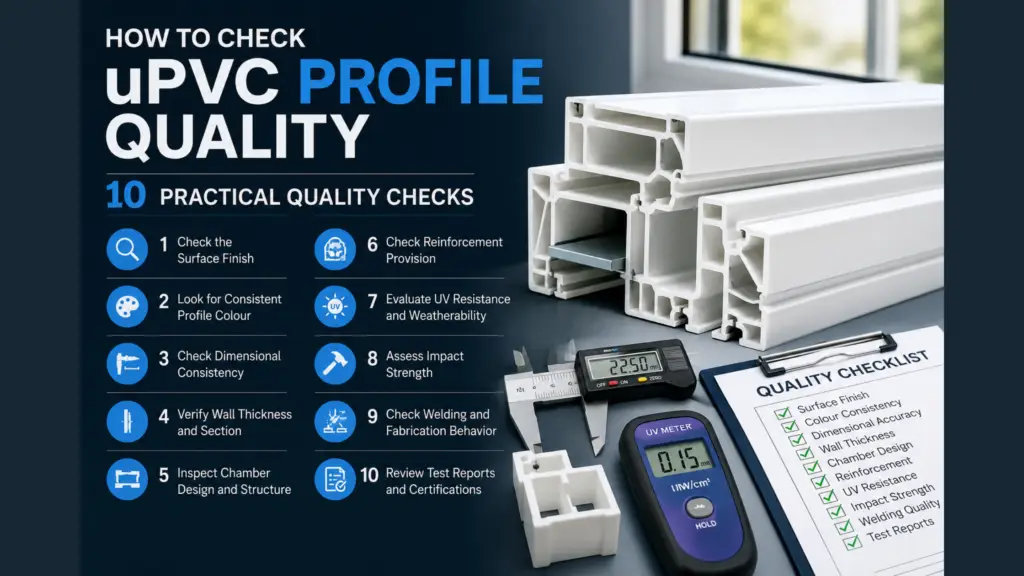
Choosing a uPVC profile should involve more than checking its colour or comparing the price per kilogram. Profile quality depends on material formulation, surface condition, dimensional consistency, structural design and resistance to environmental exposure.
To check uPVC profile quality properly inspect the profile surface, colour consistency, dimensions, wall sections, chamber design, reinforcement provision and fabrication behaviour. Technical testing for UV resistance, impact strength and material performance provides additional evidence of profile quality.
Understanding these checks helps fabricators reduce production issues and allows builders and buyers to ask better questions before selecting a uPVC profile system.
First, What Is uPVC?
uPVC stands for Unplasticized Polyvinyl Chloride.
PVC is a type of polymer used in many industrial and construction applications. The word unplasticized means the material is formulated without plasticizers that are commonly used to make some PVC products soft and flexible.
Because uPVC is rigid it is widely used to manufacture profile sections for window and door systems.
In simple terms:
PVC can be formulated for flexible applications.
uPVC is a rigid material commonly used for window and door profiles.
The final properties of a uPVC profile depend on its formulation, profile design, extrusion control and quality testing.
What Is a uPVC Profile?
A uPVC profile is the long extruded section used to fabricate the frame and sash components of a uPVC window or door system.
The profile is not the complete window.
A finished uPVC window may include:
- uPVC profiles
- Steel reinforcement where required by the system design
- Glass
- Glazing beads
- Gaskets
- Hardware
- Rollers for sliding systems
- Locks and handles
- Drainage provisions
- Welded or mechanically connected components
This distinction is important.
A good profile creates the foundation for a reliable window system. However final window performance can also depend on fabrication quality, reinforcement selection, glazing, hardware and installation.
Why Does uPVC Profile Quality Matter?
For a fabricator profile inconsistency can create problems during cutting, welding, reinforcement insertion and assembly.
For a builder inconsistent profiles may affect the quality and repeatability of window systems supplied across a project.
For a homeowner poor material selection or incorrect window fabrication may contribute to operational and maintenance problems over time.
This is why profile quality should be evaluated before bulk purchasing or fabrication.
Here are 10 practical checks that can help.
1. Check the Profile Surface Finish
Start with a simple visual inspection.
The visible surface of a uPVC profile should appear smooth and consistent. Look at the profile under good lighting rather than inspecting it inside a dark warehouse.
What should you check?
Look for:
- Pitting
- Visible cavities
- Surface impurities
- Deep lines
- Irregular patches
- Damaged edges
- Excessive surface roughness
A profile surface can provide an early indication of extrusion and handling consistency.
What is extrusion?
Extrusion is the manufacturing process used to form a uPVC profile.
The prepared uPVC compound is processed through extrusion equipment and shaped through a profile die. The profile is then controlled through cooling and calibration stages to maintain its intended shape and dimensions.
The die is the precision tooling that helps create the cross-sectional shape of the profile.
Surface inspection is one of the easiest first checks for fabricators and buyers.
2. Look for Consistent Profile Colour
Colour consistency should be checked across the visible profile surfaces.
For white uPVC profiles compare multiple profile lengths from the same supply batch under similar lighting conditions.
Do not compare one profile indoors and another profile under direct sunlight because lighting can affect visual colour perception.
What does colour consistency mean?
Colour consistency means the visible surfaces of profiles maintain a reasonably uniform appearance without unexplained colour variation.
Check:
- One profile against another
- Different sections of the same profile
- Visible surfaces near the edges
- Multiple lengths from the supplied batch
Colour alone cannot confirm complete material quality.
However unexpected variation should lead to further inspection and discussion with the profile supplier.
3. Check Dimensional Consistency
Dimensional consistency means the profile maintains the intended measurements and geometry within the required manufacturing tolerance.
This is especially important for fabricators.
Even small dimensional variations may affect how different system components interact during fabrication.
Important dimensions can include:
- Overall profile width
- Overall profile height
- Wall sections
- Glazing bead areas
- Reinforcement chambers
- Gasket grooves
- Hardware-related sections
- Interlocking areas
Fabricators should use suitable measuring equipment and approved profile drawings where available.
What is dimensional tolerance?
A tolerance is the permitted variation from a specified measurement.
Manufacturing does not mean every dimension is mathematically identical without any variation. The important factor is whether the profile remains within the specified acceptable limits.
Consistent dimensions support repeatable fabrication.
4. Understand Profile Wall Sections
The profile wall is the material section that forms the external and internal structure of a uPVC profile.
Wall design should not be judged by appearance alone.
Different profile sections can have different functions based on the system design.
Why do wall sections matter?
Profile wall design can influence:
- Structural behaviour
- Welding
- Screw fixing locations
- Profile geometry
- Fabrication compatibility
Do not assume that a heavier profile is automatically a better profile.
Profile weight can vary because of profile dimensions, chamber geometry and system design.
The correct approach is to evaluate the profile according to its intended system specification and technical requirements.
5. Examine the Chamber Design
When you look at the cross-section of a uPVC profile you will notice internal hollow sections.
These sections are called chambers.
A multi-chamber profile contains multiple internal compartments created by the profile geometry.
Why are chambers used?
Depending on the profile system chambers can support:
- Profile geometry
- Thermal performance
- Structural design
- Reinforcement provision
- System functionality
One chamber may be designed to accommodate reinforcement while other sections form part of the overall profile structure.
Does more chambers always mean better quality?
No.
Chamber count alone should not be used as the only measure of profile quality.
A profile with more chambers is not automatically suitable for every window application.
Profile geometry, dimensions, reinforcement provision and the complete window system should be considered together.
This is a common misunderstanding when comparing uPVC profiles.
6. Check the Reinforcement Provision
Reinforcement generally refers to a metal section used inside the designated reinforcement chamber of a uPVC profile where required by the window system design.
The uPVC profile and reinforcement are different components.
What is a reinforcement chamber?
A reinforcement chamber is the internal profile space designed to accommodate the specified reinforcement section.
Fabricators should check:
- Reinforcement chamber dimensions
- Reinforcement compatibility
- Ease of insertion
- Specified reinforcement requirements
- Screw fixing requirements
The type and thickness of reinforcement should be selected according to the window system, sash size, design requirements and relevant technical guidance.
Do not assume that every profile contains reinforcement when supplied.
In many fabrication processes reinforcement is inserted during window manufacturing according to system requirements.
7. Evaluate Profile Impact Performance
Impact strength describes a material’s ability to resist damage when subjected to a sudden force or impact under specified test conditions.
This does not mean hitting random profile samples with a hammer on the factory floor.
A proper impact-related test follows a defined testing method.
Why does impact performance matter?
uPVC profiles can experience handling and fabrication stresses during:
- Transportation
- Storage
- Cutting
- Fabrication
- Assembly
Material behaviour should be evaluated through appropriate test methods rather than informal demonstrations.
When evaluating a profile manufacturer ask whether relevant material and profile testing documentation is available.
A laboratory test report provides more useful technical evidence than a marketing claim such as “unbreakable profile”.
8. Check UV Resistance
UV means ultraviolet radiation.
Ultraviolet radiation is part of the energy emitted by sunlight.
Window and door profiles installed on buildings can experience prolonged sunlight exposure. This makes UV-related material performance particularly relevant in regions with strong solar exposure.
What is UV resistance?
UV resistance refers to the ability of a material or formulation to resist degradation associated with ultraviolet exposure under defined conditions.
UV performance can be influenced by the profile formulation and stabilisation system.
What should a buyer or fabricator ask?
Ask for available technical or laboratory documentation related to UV resistance.
Do not depend only on phrases such as:
“Made for sunlight”
“Weatherproof quality”
“Never fades”
Technical documentation creates a clearer basis for evaluation.
9. Check Profile Behaviour During Fabrication
A profile may look good in storage but fabricators also need to evaluate how the profile behaves during actual fabrication.
This is where production experience becomes important.
Check the profile during:
- Cutting
- Reinforcement insertion
- Routing
- Drainage preparation
- Hardware preparation
- Welding
- Corner cleaning
- Glazing bead fitting
- Final assembly
What is weldability?
Weldability refers to the ability of compatible uPVC profile sections to form a suitable welded joint under the correct fabrication conditions.
Welding quality does not depend on the profile alone.
Machine condition, temperature settings, welding time, profile preparation and operator process can also affect the final joint.
If a fabricator experiences repeated production issues investigate both the profile and the fabrication process before identifying the cause.
10. Ask for Quality Testing Evidence
One of the strongest ways to evaluate technical claims is to ask for relevant testing documentation.
Depending on the profile and applicable requirements testing may examine factors such as:
- UV resistance
- Profile appearance
- Material properties
- Impact-related performance
- Dimensional characteristics
- Thermal material behaviour
What is a test report?
A test report is a technical document that records the test method, sample details, requirements and obtained results where applicable.
Read the actual report.
Do not only look at the laboratory logo.
Check:
- Name of the tested product or sample
- Test method
- Test date
- Requirement
- Obtained result
- Report identification
- Testing organisation
Testing terminology can appear complicated but these details help buyers and fabricators separate documented information from general marketing statements.
Quick uPVC Profile Quality Checklist
| Quality Check | What to Look For | Possible Concern |
|---|---|---|
| Surface Finish | Smooth and visually consistent surface | Pitting, cavities or visible defects |
| Colour | Uniform visible colour | Unexplained colour variation |
| Dimensions | Consistent profile geometry | Variation affecting fabrication |
| Wall Sections | System-specific profile structure | Incorrect comparison based only on weight |
| Chambers | Functional internal profile design | Judging quality only by chamber count |
| Reinforcement Provision | Compatible reinforcement chamber | Incorrect reinforcement selection |
| Impact Performance | Relevant testing evidence | Informal strength demonstrations |
| UV Resistance | Technical documentation | Unsupported weather claims |
| Fabrication Behaviour | Consistent processing | Repeated cutting, welding or fitting issues |
| Test Reports | Clear test methods and results | Marketing claims without technical evidence |
Common uPVC Profile Terms You Should Know
uPVC
Unplasticized Polyvinyl Chloride. A rigid polymer material commonly used for window and door profile systems.
Profile
An extruded section used as part of a window or door frame, sash or related system component.
Extrusion
The manufacturing process used to form a continuous uPVC profile section.
Die
Precision tooling used to create the required profile cross-sectional shape during extrusion.
Calibration
A controlled stage in profile production that helps maintain the intended profile shape and dimensions.
Chamber
An internal hollow section within the profile geometry.
Multi-Chamber Profile
A profile designed with multiple internal chambers.
Sash
The part of a window that holds the glass. Depending on the window design the sash may be fixed or operable.
Frame
The main outer structure of the window system that is installed into the building opening.
Glazing Bead
A profile component used to help retain the glass or glazing unit within the window or door system.
Gasket
A flexible sealing component used at specified areas of a window system.
Reinforcement
A metal section inserted into a designated profile chamber where required by the system design.
Dimensional Tolerance
The permitted variation from a specified profile measurement.
UV Resistance
The ability of a material to resist degradation associated with ultraviolet exposure under defined conditions.
Impact Strength
A material property related to resistance against sudden force under specified test conditions.
Weldability
The ability of compatible profile sections to form a suitable welded joint under controlled fabrication conditions.
Fabricator
A business or professional that converts uPVC profile systems and related components into finished windows and doors.
Common Mistakes When Checking uPVC Profile Quality
Mistake 1: Judging Quality Only by Profile Weight
A heavier profile is not automatically a better profile.
Profile size, geometry and system design can affect weight. Technical specifications should be compared before making a conclusion.
Mistake 2: Counting Chambers and Choosing the Highest Number
More chambers do not automatically mean better overall window performance.
The complete profile system and window design matter.
Mistake 3: Checking Only the White Colour
A bright white surface does not confirm structural or material performance.
Dimensions, profile design and available testing evidence should also be reviewed.
Mistake 4: Assuming the Profile Is the Complete Window
The profile is one part of a finished uPVC window.
Glass, reinforcement, gaskets, hardware, fabrication and installation can also influence final performance.
Mistake 5: Trusting Marketing Claims Without Reading Test Reports
Words such as strong, durable and weather resistant need technical context.
Where testing documentation is available check the test method and obtained results.
S Craft Perspective
From a uPVC profile manufacturing perspective consistency is one of the most important factors for fabricators.
A profile system needs controlled geometry, appropriate material performance and repeatable dimensions to support efficient fabrication.
S Craft manufactures uPVC profile systems for window and door applications using profile extrusion and quality control processes. The S Craft profile range includes systems for sliding, casement and supporting profile applications.
For fabricators the practical approach is to evaluate profile quality through visual inspection, dimensional checks, fabrication behaviour and available technical documentation.
A uPVC profile should not be selected based on a single marketing feature. Profile formulation, geometry, manufacturing consistency and compatibility with the complete window system should be evaluated together.
Frequently Asked Questions About uPVC Profile Quality
1. How can I check uPVC profile quality before buying?
Start by inspecting surface finish, colour consistency and profile dimensions. Review the profile cross-section, chamber design and reinforcement provision. Fabricators should also evaluate cutting and welding behaviour. Ask the manufacturer for relevant technical testing documentation where available.
2. What is the difference between PVC and uPVC?
PVC is polyvinyl chloride and can be formulated for different applications. uPVC means unplasticized polyvinyl chloride. It is a rigid material commonly used to manufacture profile sections for window and door systems.
3. Is a heavier uPVC profile always better?
No. Profile weight alone does not determine quality. Profile dimensions, geometry, wall design and intended application can affect weight. Compare profiles based on system specifications, material performance and manufacturing consistency.
4. Are more chambers better in a uPVC profile?
Not automatically. Chambers form part of the internal profile geometry. Chamber design should be evaluated with profile dimensions, reinforcement provision and the intended window system. Chamber count alone is not a complete quality measurement.
5. Why is UV resistance important for uPVC profiles?
Window and door profiles can experience long-term sunlight exposure. UV resistance relates to how the material responds to ultraviolet exposure under defined conditions. It is particularly relevant when evaluating profiles intended for external building applications.
6. What is dimensional accuracy in a uPVC profile?
Dimensional accuracy refers to how closely a manufactured profile matches its specified measurements and geometry. Controlled dimensions help profile components fit and function consistently during window and door fabrication.
7. Does a good uPVC profile guarantee a perfect window?
No. A quality profile provides an important foundation but the finished window also depends on fabrication, reinforcement, glass, gaskets, hardware and installation. The complete system should be evaluated.
8. What should fabricators ask a uPVC profile manufacturer?
Fabricators should ask about available profile systems, technical drawings, reinforcement requirements, fabrication guidance and relevant test documentation. They should also evaluate supply consistency and profile behaviour during actual fabrication.
Continue Learning
Explore S Craft uPVC Profiles
Understand the profile systems manufactured for modern window and door applications.
Understanding Casement Profile Systems
Learn how profile sections support casement window and door fabrication.
Understanding Sliding Profile Systems
Explore the profile systems used for sliding window and door applications.
Looking for uPVC Profiles for Your Fabrication Business?
Evaluating profile quality should begin with technical clarity rather than marketing claims.
Speak with the S Craft team to understand available uPVC profile systems, fabrication requirements and profile supply support for your business.